
THE VALUES THAT INSPIRE US
Felicity
We believe in making our own trends. We believe in embracing a certain je ne sais quoi. We believe a little bit of mystery and antique language helps to add a bit of spice and color to an increasingly flat world.
Charm
We strive to capture the playful and timeless—but never stuffy—qualities of Baroque French design in every piece. We know that human design is always superior because without humanity there is no art.
Grace
Women deserve elegant merchandise options that can last them a lifetime, but more often than not women’s fashion is designed for the short term. In the modern day, we believe that product quality can and should match historical standards.
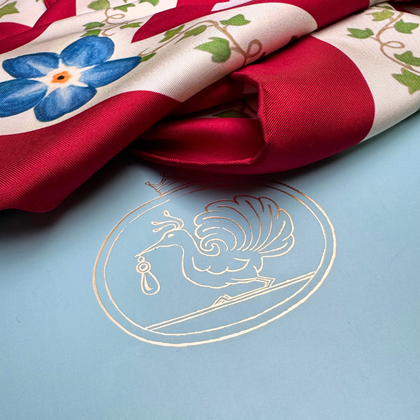
The essence of Les Précieuses is préciosité.
Read more about our historical inspiration below.
“The Marquise de Rambouillet was that unusual something, a born social leader…
In a corrupt age, she made virtue fashionable.”
Leon Vincent, Hôtel de Rambouillet and the Précieuses, 1900
Who Were Les Précieuses?
In early seventeenth-century France, long before the tragically fragile decadence of Marie Antionette and her entourage garnered worldwide infamy for French noblewomen, les précieuses formed the vanguard of French social and intellectual life. While the moral degradation of French politics deepened, les précieuses exercised their nobility by becoming patrons of the arts. Their houses were the workshops of the French language as it first developed its literary form. They invented new words and genres of writing, from fairy tales to the historical novel. Their criticism became the standard by which society would measure a writer’s success. Yet, for all their grandiose achievements, they were delicate in their methods. Truly their success was due to the elevation of a rather simple premise: that there is nothing more satisfying than good conversation among friends.
Unfortunately, posterity has been unkind to les précieuses, and most people are unaware of their myriad accomplishments. They were women who did not simply excel in pursuits defined by men, but rather invented their own. Far from being historical curiosities, they proved instrumental in curating the environment that came to define the Grand Siècle, France’s Golden Age of high art and culture. They have been woefully underappreciated not chiefly because they were women but because—with notable exceptions—they seldom found their greatest influence to be exerted through the written word. Their greatest contribution to world history was the birth of the salon, perhaps the most influential humanist institution to be born in Paris.
The Hôtel de Rambouillet
Where now stands the Louvre, and before then the Tuileries, stood a noble residence. Perhaps it is not so surprising to observe that the world’s first salon fell into obscurity when it was succeeded by the crown jewel of French curation. Then again, it is entirely fitting. It was here, at the beginning of the seventeenth century, that the famous French taste was first defined. Without its mistress, however, the building was nothing.
Catherine de Vivonne, Marquise de Ramboulliet, was a woman without equal. Born in Rome to Italian nobles, she imported a remarkable taste for striking color and movement from the nascent Italian Baroque movement, one which appealed to the increasingly wealthy nobility of France. She began her illustrious career in her living room, which soon became known as la chambre bleu, in recognition of its unique blue walls and decorations. The term salon was not yet in use because the very institution itself developed in la chambre bleu. Only in the mid-seventeenth century did French speakers begin to break from the naming precedent set by the Hotel de Ramboulliet, in which a woman’s salon was simply known by the name of the room. It was just the room in which letters were read, poems were debuted, and conversations were had. But the manner of the Marquise de Ramboulliet was such that her words carried more weight than most men in Paris.
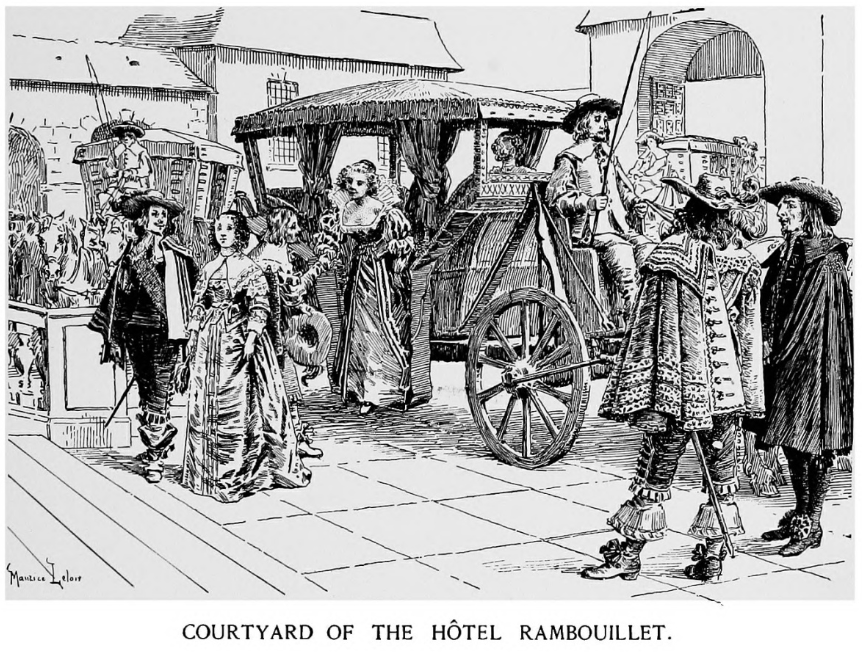
Engraving by Maurice Leloir in The women of the French salons. By Amelia Gere Mason. New York: The Century Company, 1891.
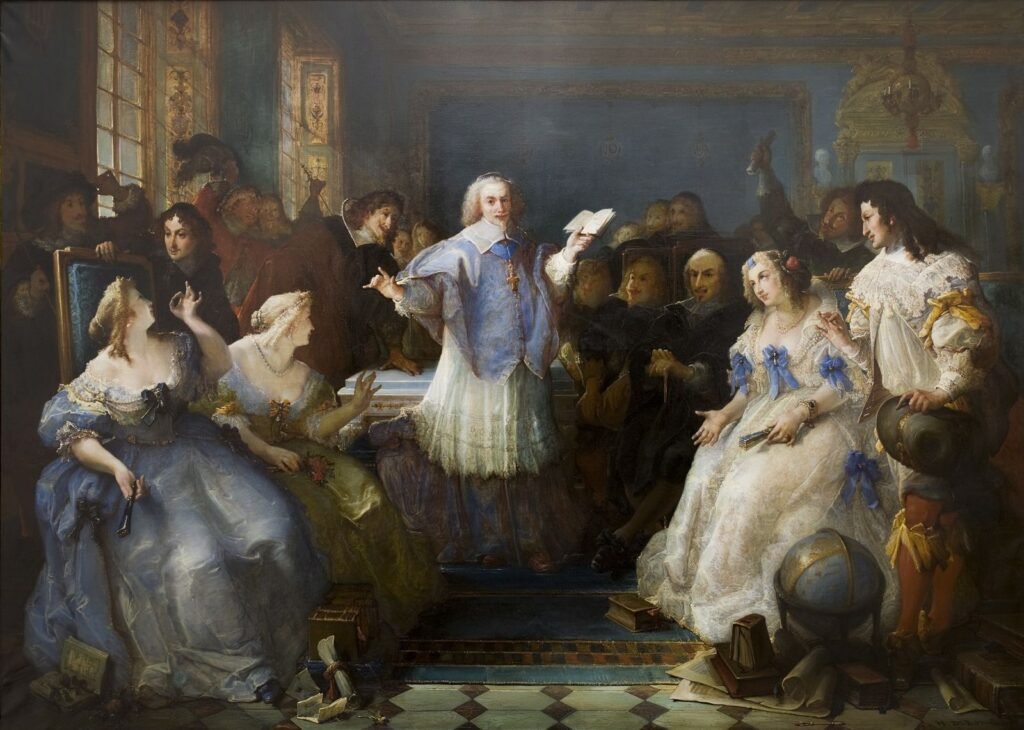
Scene from a salon at the Hôtel de Rambouillet by Francois-Hippolyte Debon, 1863. Musée d’Art et d’histoire de Dreux, Eure-et-Loir, France.
Perfecting the Art of Good Conversation (and Fun)
When one reads about the momentous achievements of past societies, it is easy to be enraptured in the image of greatness without texture. In other words, it is one thing to know that these women were influential and respected in their time, but it is entirely another to imagine ourselves in their place and thus to appreciate in its context their glorious genius. The giddy anticipation of having a new costume made so that we may surprise and stun as the goddess Aphrodite. The nervous excitement of debuting one’s favorite poet to be judged by the other women. To brush shoulders with the highest authorities on God and to be treated as an equal. to speak their language, feel the drama of courtly love pulse through poetry.
La chambre bleu became an enchanted space, merging the high art of verse, science, and philosophy with the joyous and playful spirit of gallant poetry. Rather than reading Greek plays, they would act them out in costume. These were the famous fêtes of the Hotel de Ramboulliet. Similarly, banal and simple conversation was considered too vulgar within the blue walls of the Marquise’s home. Instead, she encouraged her guests to spark their creativity of language by inventing all manner of metaphors for everyday objects. For example, if you were to attend an evening soirèe with the Marquise de Ramboulliet, you may have begun by calling on the counselor of graces (the mirror) to evaluate your present condition, after which you would avail yourself to the conveniences of conversation (armchairs). You would see the blue walls illuminated from the seat of Vulcan (the fireplace) aided by the supplements of the Sun (candles). If the evening’s poet was gifted enough, he could paint red the throne of modesty (cheeks) and even call forth the pearls of the iris (tears)!
Those who frequented the salon—or habitués as they came to be known—were among the most brilliant minds in France. Jean-Louis Guez de Balzac, Vincent Voiture, Jean Desmarets, Valentin Contrart, Antoine Godeau, Honorat de Bueil, Guillaume Colletet, Jean Chapelain, all served as inaugural members of the Académie française after its founding in the 1630s. Almost a quarter of the first lifetime chairs were elected from Madame de Ramboulliet’s circle. The formation of the Académie française itself was sponsored by Cardinal Richelieu, the Red Eminence, by most accounts the most powerful man in France above even King Louis XIII himself. He certainly attended more than one seminar at la chambre bleu, and even when he was absent he sent letters inquiring about what was said.
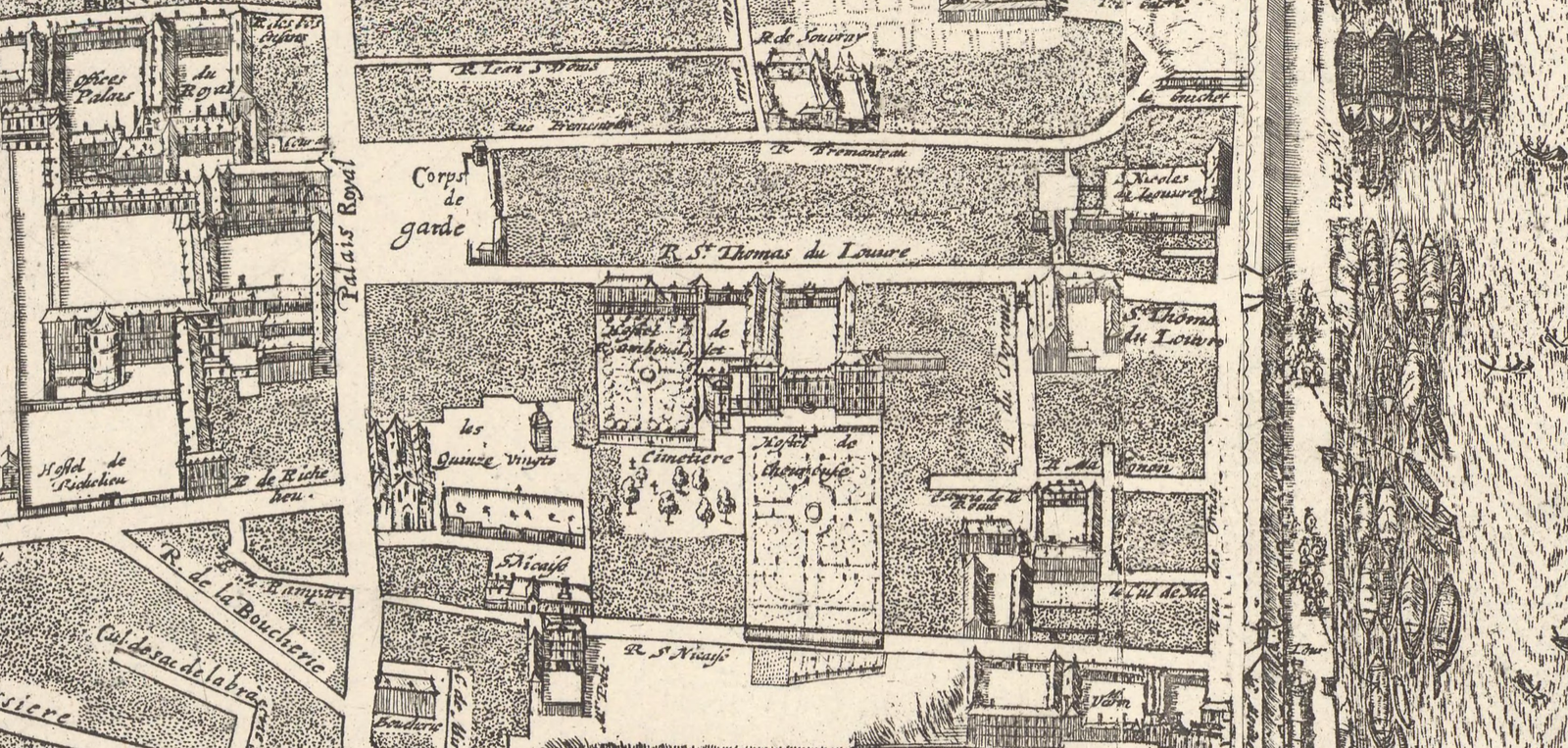
Lutetia. Paris en 1652. Fac-similé du plan de Jacques Gomboust. David Rumsey Historical Map Collection.
Of course, it was not long before critics saw these women as nothing more than glorified hostesses. While the women of the first salons had occasionally referred to themselves as “précieuses,” the term entered public discourse in the context of mockery. In 1659, the French playwright Molière satirized the women of the salon in his short comedy, Les Précieuses ridicules. In French, the phrase literally translates to “the precious ones,” but the implication was one of immaturity and affectedness. Owing to their excessively obscure language and the onerous requirements they made of potential suitors, les précieuses were portrayed as nothing more than a sanctuary of feminine frivolity. But, Marquise de Ramboulliet herself attended the performance and never was recorded taking offence. Why should she? A woman so confident of her own value takes no offense at inaccurate mockery, and nothing could have been further from the atmosphere of her chambre bleu. Molière’s satire, then, was not a criticism of all the women of the salons, but what he observed to be a growing tendency to turn the salon into a form of hollow entertainment and a means to claim undeserved social status. Indeed, by the eighteenth century, the refined manner of the early précieuses had been thoroughly forgotten.
What to look for in a seventeenth-century man…
“A lover, to be agreeable, must understand how to utter fine sentiments, to breathe soft, tender, and passionate vows; his courtship must be according to the rules. In the first place, he should behold the fair one of whom he becomes enamoured either at a place of worship, or when out walking, or at some public ceremony; or else he should be introduced to her by a relative or a friend, as if by chance, and when he leaves her he should appear in a pensive and melancholy mood. For some time he should conceal his passion from the object of his love, but pay her several visits, in every one of which he ought to introduce some gallant subject to exercise the wits of all the company. When the day comes to make his declarations—which generally should be contrived in some shady garden-walk while the company is at a distance—it should be quickly followed by anger, which is shown by our blushing, and which, for a while, banishes the lover from our presence. He finds afterwards means to pacify us, to accustom us gradually to hear him depict his passion, and to draw from us that confession which causes us so much pain. After that come the adventures, the rivals who thwart mutual inclination, the persecutions of fathers, the jealousies arising without any foundation, complaints, despair, running away with, and its consequences. Thus things are carried on in fashionable life, and veritable gallantry cannot dispense with these forms. But to come out point-blank with a proposal of marriage,—to make no love but with a marriage-contract, and begin a novel at the wrong end! Once more, father, nothing can be more tradesmanlike, and the mere thought of it makes me sick at heart.“
Molière, Les Précieuses ridicules, 1659
Romance and the Salon
What laudable standards! Who wouldn’t want a love story grounded in those very scenes of dramatic passion? Molière had—if nothing else—eloquently articulated the perfect romance centuries before Pride and Prejudice or The Notebook. We can only assume that he captured this feminine vision because he had observed that, even in the golden age of les précieuses, the women of the salon maintained a standard for courtship that was hard-won and not for the feint of heart. Nowhere was their commitment to love more evident than in the courtship of the Marquese de Ramboulliet’s very own daughter Julie d’Angennes. Born in 1607, Julie was raised in the constant presence of the distinguished habitués of her mother’s salon. In the literary court of la chambre bleue, she became “Princesse Julée,” a title she embraced. Her beauty, elegance, and intellectual taste brought her much attention, but perhaps even more remarkable was her boundless energy and delightful attitude. It was she who organized many of the fêtes of her mother’s circle, as she embraced her passion for the dramatic.
When she was 24, she caught the eye of a more determined suitor, the Marquis de Montausier, a military officer three years her junior. After a decade of competing for her affection with the other notables of the Hotel de Ramboulliet, he attempted a romantic gesture so grand that it’s own legacy has come to eclipse theirs. In 1641, he presented her with the Garland of Julie, a collection of sixty-one poems by the greatest literary minds of the age, all describing how a particular flower sings the praises of “the incomparable Julie.” Even after this, the Marquis de Montausier waited four years for Julie to accept his proposal, going so far as to convert to her Catholic faith for her hand in marriage.
Julie’s reluctance seemed less to do with Montausier himself than with the logistical constraints of marriage itself. She would have had to relinquish her favorable position at the Hotel de Ramboulliet, the social and intellectual center of her universe, once marriage separated her from the household of her parents. Though her marriage soon led to social gain—for she was appointed first lady-in-waiting to the Queen of France, Maria Theresa—it was a disappointing success. The court of King Louis XIV was an unstable battleground of palace intrigue and flagrant indiscretions. It did not attract or reward the same kind of refinement she had come to know at the Hotel de Ramboulliet. Indeed, Julie’s marriage–coinciding with the ascension of the absolutist Louis XIV–marked the decline of the salon at la chambre bleu.
In this context, it becomes clear why the précieuses of the early seventeenth century sought their own space, free from the violent, unrefined men within the French court, and far from its poisonous obsession with power. Of course, concerns about manners could verge on the excessive, but it was this very obsession with refinement, virtue, and intellect that protected the salon from becoming yet another area where men felt at liberty to exercise their crude will to dominate.
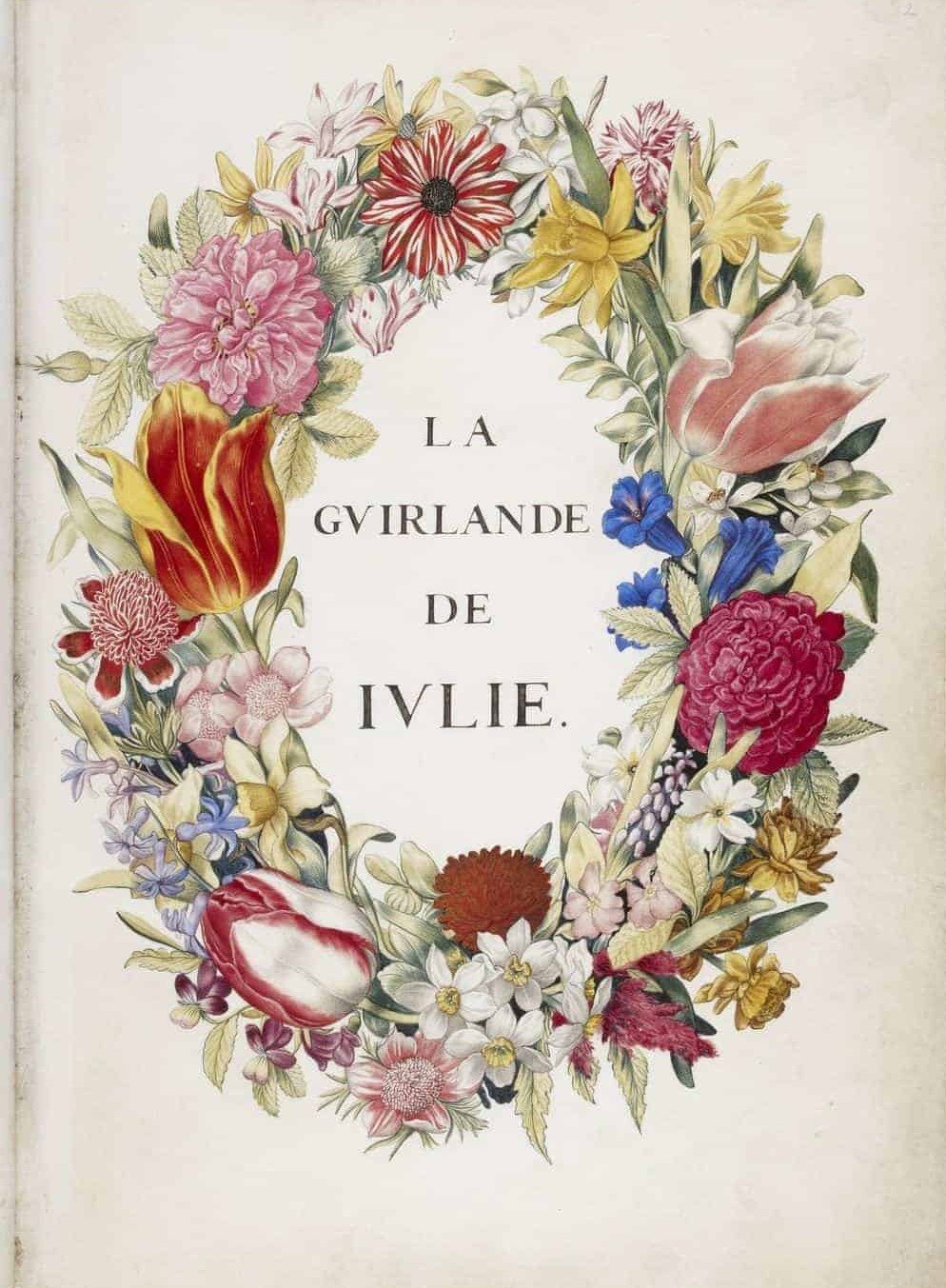
The Garland of Julie, 1641. Illustration reproduced in Nicolas Robert and Octave Uzanne, La guirlande de Julie, Paris: Librairie des Bibliophiles, 1875
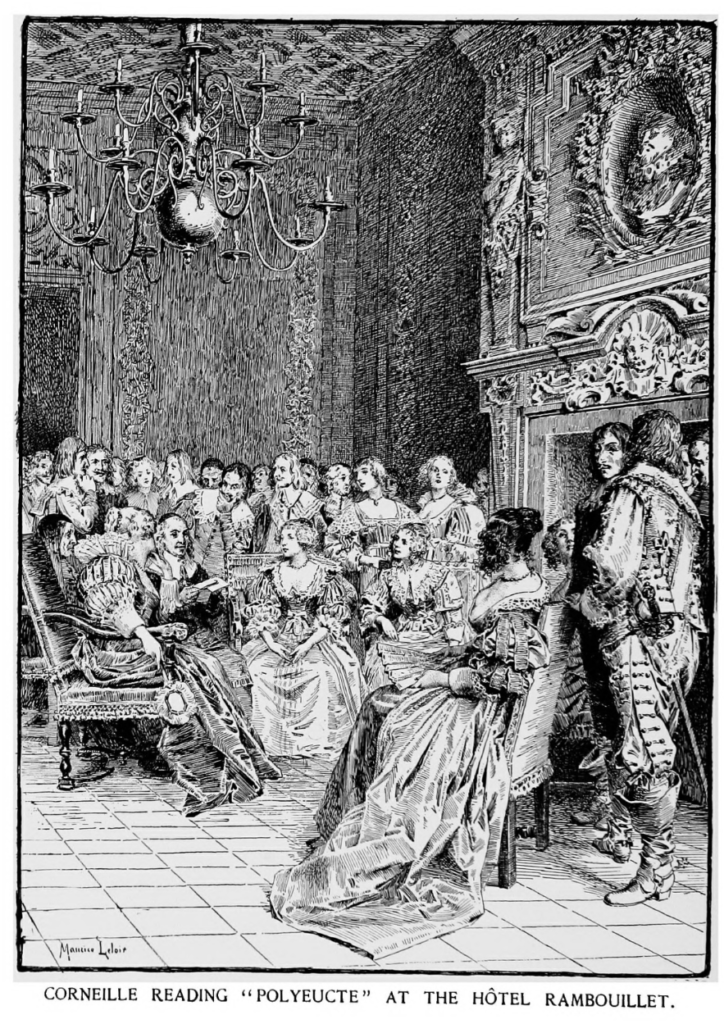
Engraving by Maurice Leloir in The women of the French salons. By Amelia Gere Mason. New York: The Century Company, 1891.
Women of Letters
The sixteenth century had seen the explosion of printed books and pamphlets, and the rise of well-known intellectuals like Erasmus of Rotterdam, a pioneer of this type, who established an international community through the exchange of detailed correspondence. Such “men of letters” became synonymous with the exponential growth of knowledge in the wake of the Renaissance, but their work was often done in the service of impatient or domineering royal patrons—or worse, they lacked institutional support from any source. This new kind of intellectual was relatively unmoored in the sixteenth century, especially if they did not belong to the clergy. Enter the Hotel de Ramboulliet, which by providing a community devoted to intellectual pursuits and independent of great power politics, helped transform the disparate intellectual elements of seventeenth-century France into a lively “Republic of Letters.”
Les précieuses were chiefly responsible for turning the writing of letters into an art form. They saw past the practicality of letters written to inform—or letters written to articulate an argument. Art for art’s sake, writing well for the sake of writing well, these premises formed the belles-lettres movement. The Marquise de Ramboulliet in particular demanded a high quality, but she delivered in return. Here again we see why it is so easy to lose the legacy of les précieuses to time. Most of their literary output was in letters and not in published materials, as they would have circulated their correspondence to all who needed to read it. Chiefly then, the legacy of the Marquise de Ramboulliet lived on in those with whom she corresponded, and especially with those women who had been her sisters in la chambre bleu.
We can see her influence most directly through the figure of Marie de Rabutin-Chantal, Marquise de Sévigné. Not only did de Sévigné form her own literary salon in the image of her predecessor, she was renowned too for her letters. Fortunately, we have an extensive collection of her letters to her daughter, which are now considered among the greatest of the genre.
Another great student of la chambre bleu turned her literary efforts to a more lasting medium. Marie-Madeleine Pioche de La Vergne, Comtesse de La Fayette, was the author of France’s first historical novel, La Princesse de Clèves. Like all of the women of the salon, she was of course recognized as influential in her time, but the Comtesse has the added honor of being considered model for the modern psychological novel as well.
Occasionally, and especially after the golden age of la chambre bleu, les précieuses engaged openly in social and political criticism (which were in that age much more clearly the same thing). Of course, one could not imagine any serious gathering of humanist minds to have avoided such topics altogether, but some women had more discretion than others. Madeleine de Scudéry was infamous for her social criticism and flaunting of social norms. She wrote under the provocative sobriquet Sappho, and she scandalously remained unmarried to the end of her life. While her works are voluminous, none are so long as her magnum opus Artamène, ou Le Grand Cyrus, which most regard as the longest novel ever written in any language. Importantly, she and her brother wrote this work as a roman-à-clef, a novel with a key, meaning that all of its characters had real-world counterparts which would be revealed if the reader were provided with the accompanying list. From de Scudéry’s work we get a wonderful illustration of the Marquise de Ramboulliet, who is written into the character “Cleobuline.”
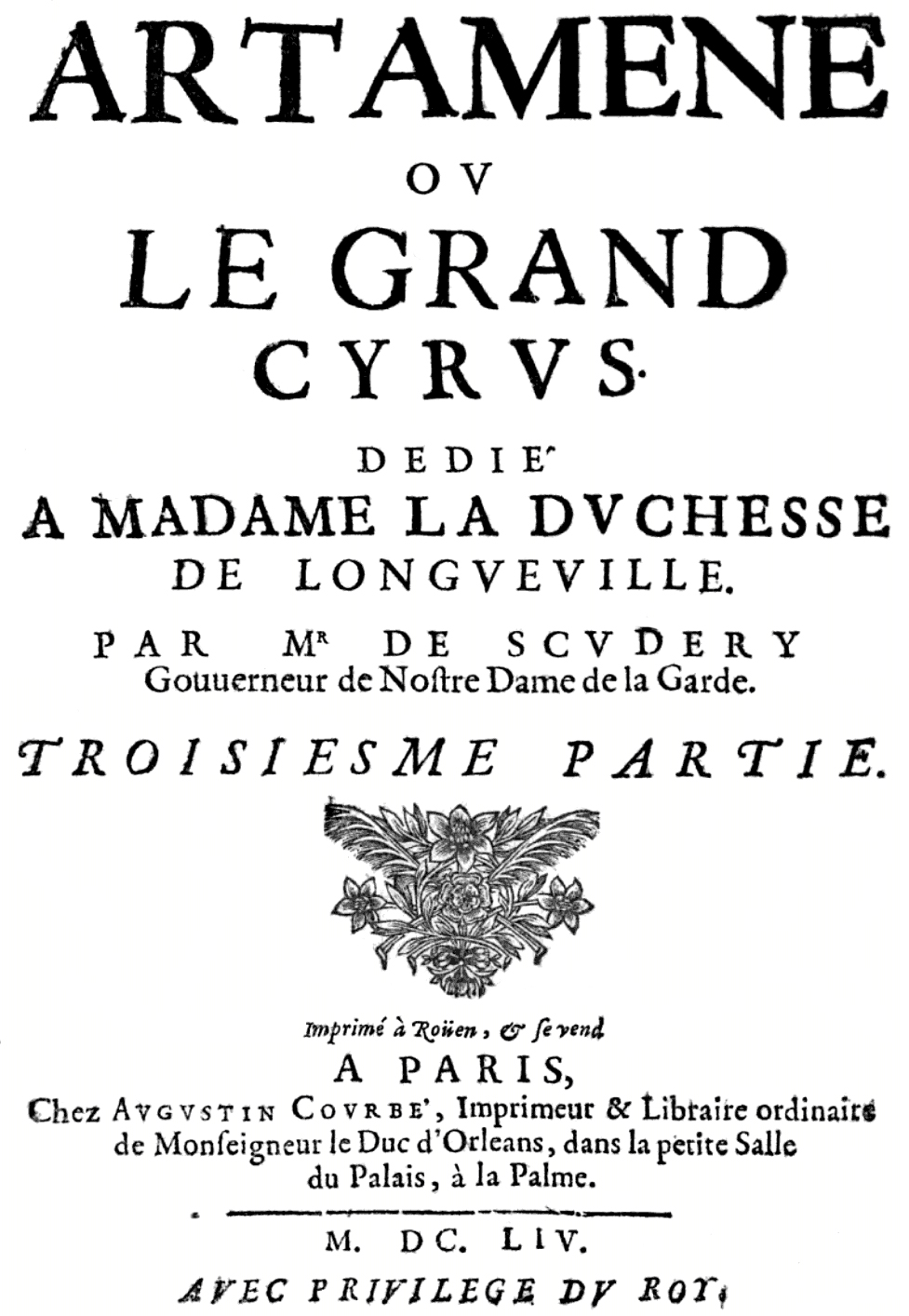
A Sisterly Ode to the Madame de Ramboulliet
“Though Cleobuline be not so high as her heart is great, yet in exchange, she hath the fairest grey eyes that ere were seen, her hair the loveliest fair in the world, her garb and behaviour superlatively rare; and though her Nose be a little above the true exactness of proportion, yet her physiognomy is so Noble and Heroique, as it pleaseth infinitely, and as I said before, inspires reverence into the hearts of all beholders: But Sir, I do not only render her commendable unto you, by the graces of her person; but also by the grandure of her soul, the nobleness of her inclinations, the generosity of her heart, and the incomprehensible altitude of her wisdome and spirit: For it is most unquestionably certain, that never any one living had greater and more admirable qualities then this Princess hath, she speaks unto all Ambassadors which come unto her Court in their own National language, and that with such eloquence, with so much ease, and in such a grace, as puts them all to admiration. Moreover, her knowledg is not limited to the languages which she speaks and writes as well as her own, but there is no manner of Science whereof she is not capable: Yet the thing which in my phancy merits most esteem is, that she hath such a venerable opinion of all persons that are either knowing or virtuous, or excellent in any Art, that at this very present she hath intelligencers in all places of the world to enquire out those who have any extraordinary merit, and by this means there is not any man of any transcendent parts who hath not tasted of her liberality: For Sir, be pleased to know, that this great Queen doth give, as if the Gods had established her to inrich all the knowing men in the world; and certainly she hath good reason for it to look upon them as her Subjects, since I am confident there is not one who does not respect her as if she were his legitimate Queen; she does not only give to those who ask her, but unto those who never pretend unto any thing, she gives quickly, she gives much, she gives description with a good will, she gives with joy, and liberality is a virtue, which she practiseth in such a Noble and Heroique manner, as she never thinks she gives too much: But the wonder of all is, that this virtue is no blinde hood-wink’t virtue which bestowes without choice or discretion; but on the contrary, she gives only unto those whom she thinks do merit her gift, yet still measuring them by the rule of her own generosity, more then by the virtue of the Receivers; much rather chusing to give more then is deserved; then not to give as much as her Quality, and liberal inclination prompts her unto. Moreover, this virtue of liberality, which is so proper unto Kings and Princes, is not the only virtue which shines in her, but also she is exceedingly good, profoundly prudent, and exactly just, so just that she will violate all her strongest inclinations, rather then do the least injustice to the meanest of her Subjects; and if this virtue which is the very Basis of all others do at any time transgress, it is only when clemency prompts her to pardon some Noble Delinquent; indeed she knows so well how to mix the severity of Justice with the mildness of clemency, that from these two virtues do flow a milion of good effects, which makes her to be both feared and loved by all her people. Moreover, she is able to give advice; she is knowing in all affairs, and understands them so admirably well, that it is a hard matter to pose her in any thing; she never frequents any but magnificent Feasts in her Court, and stately recreations; but the predominate passion of her soul is Love unto the Sciences, and she may as well be called Queen of the Muses, as Queen of Corinth; and indeed they do in all places pay her homage, in perpetual Elogies and Panegeriques, both in Verse and Prose; the name of Cleobuline is celebrated in all places of the world, and her glory is above any additions.“
Madeleine and Georges de Scudéry, Artamène, ou Le Grand Cyrus. Translated by F. G. Gent, 1653.
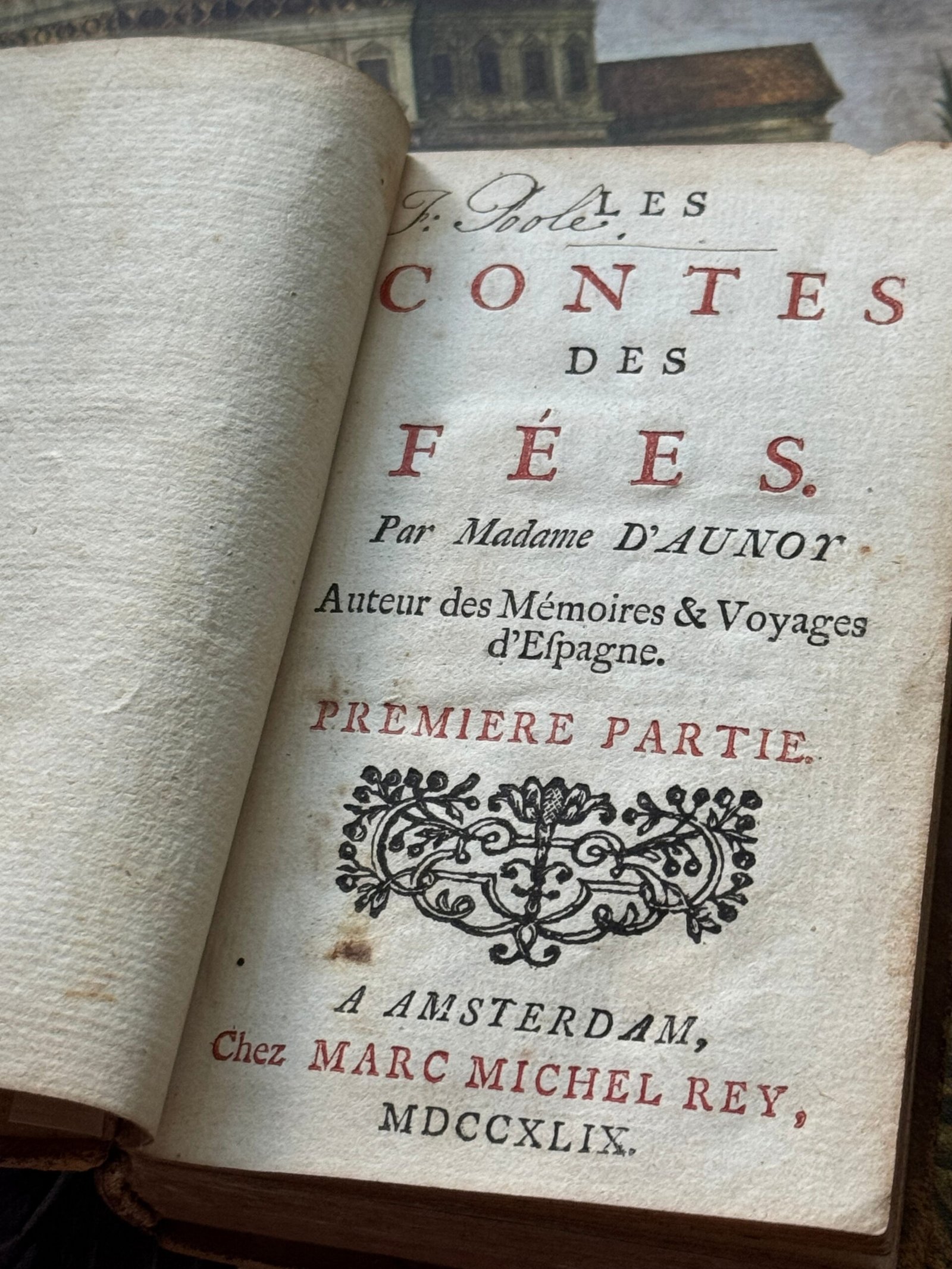
Aulnoy’s magnum opus. The pictured copy was a gift for our artist’s twenty-first birthday.
Fairy Tales and Les Précieuses
Towards the end of the Grand Siècle, the legacy of the Hotel de Ramboulliet had borne fruit in all corners French society. It was only fitting that the culmination of this era was the fairy tale genre, a style that presented the deepest cultural motifs with childlike imagination.
It was upon beginning her study of French literature that Audrey rediscovered her favorite fairy tale from her childhood: L’Oiseau Bleu, or The Blue Bird. This story, written by Madame D’Aulnoy in the late seventeenth century, follows a lovely Princess and King Charming. In their quest to be together, King Charming is transformed into a regal blue bird, and brings precious jewels to the princess in her tower. The logo for Les Précieuses is inspired by his noble gifts and traditional printers’ ornaments from the Baroque period.